
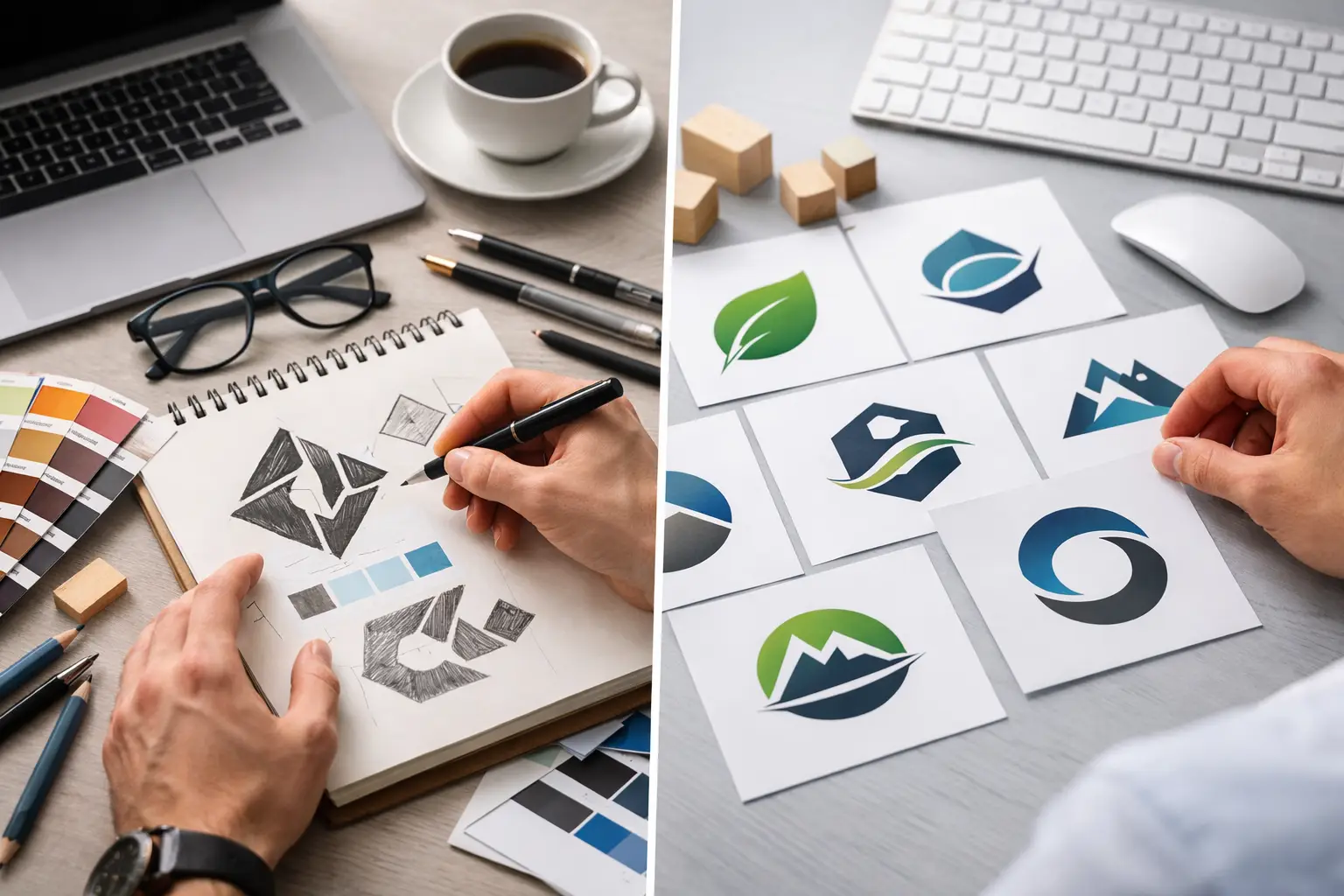
A logo often has to work before a small business owner gets the chance to explain anything. It appears on a truck, invoice, storefront sign, social profile, proposal, and customer review page. The choice between custom logo design versus template logos affects more than appearance. It can influence how credible, memorable, and established your business feels at every customer touchpoint.
For a business watching its budget, templates can be tempting for good reason. They are fast, affordable, and can look polished at first glance. A custom logo requires more planning and a larger upfront investment. The right choice depends on where your business is now, how it earns trust, and how much you need your brand to stand apart.
What a Template Logo Really Gives You
A template logo is a pre-made design that you customize with your business name, colors, and sometimes an icon. Many are available through online logo makers, design marketplaces, or subscription platforms. They can be useful when you need something presentable quickly, such as for a new side business, a short-term promotion, or an early-stage venture testing an idea.
The main advantage is speed. A business owner can choose a layout, enter a name, and have files ready within a day. The cost is usually low, which matters when funds need to cover insurance, equipment, inventory, staffing, or a new website.
The trade-off is that the design was not created around your business. Other companies may use the same icon, similar layout, or nearly identical colors. Even if the logo looks clean, it may not communicate why customers should choose you over another local provider.
Templates also tend to favor familiar visual shortcuts. A cleaning company may get a sparkle icon, a real estate agent may get a house roofline, and a consultant may get a generic abstract shape. Those symbols are not always wrong, but they rarely create a strong point of recognition when every competitor is using a variation of the same idea.
What a Custom Logo Is Designed to Do
A custom logo is developed specifically for your company, audience, services, and goals. Rather than starting with a pre-built mark, a designer starts with questions: Who are your best customers? What do they need to feel before they contact you? What makes your offer different? Where will people encounter your brand most often?
That process results in a visual identity with a purpose. For example, a premium home remodeling company may need a mark that feels precise and established, while a family-focused daycare may need one that feels warm, clear, and reassuring. Both need professionalism, but the visual language should not be the same.
Custom work also gives you more control over the details that matter in daily marketing. The logo can be built to remain readable on a business card, yard sign, vehicle decal, embroidered shirt, social media profile, and website header. The designer can prepare appropriate file types and variations so the logo performs well instead of being stretched, blurred, or awkwardly cropped.
A strong custom logo does not need to be complicated. In fact, the best marks are often simple. The difference is that the simplicity is intentional. Every color, type choice, proportion, and graphic element supports the business you are building.
Custom Logo Design Versus Template Logos: The Real Cost
The upfront price difference is clear. A template may cost little or nothing, while a custom logo can be a meaningful business expense. But the cheapest option is not always the lowest-cost option over time.
If a template logo creates confusion, looks too similar to a competitor, or fails to reproduce well across marketing materials, you may end up replacing it sooner than expected. Rebranding later means updating your website, print pieces, signs, uniforms, packaging, email signatures, and social graphics. That cost can quickly exceed the amount saved at the beginning.
On the other hand, not every new business needs a full custom identity on day one. If you are validating a concept, operating temporarily under a simple name, or have not yet clarified your services, a template can be a practical bridge. The key is to treat it as a temporary solution rather than a permanent brand foundation.
Custom design makes the most financial sense when your reputation directly affects sales. Local service businesses, professional firms, contractors, wellness providers, restaurants, retail brands, and businesses competing for referrals all benefit from stronger visual credibility. When customers are comparing several options online, a polished and distinctive brand can help your business earn the next click or call.
Ownership and Originality Matter More Than They Seem
Before choosing a template, review its license carefully. Some platforms allow commercial use but do not give you exclusive rights to the icon or overall design. Others limit how you can use the artwork, especially in trademark registration, resale, or high-volume printing.
That can create problems as your company grows. You may invest in signage and marketing only to discover that another business has a very similar logo. Even if there is no legal dispute, the overlap can weaken brand recognition and make your company harder to find or remember.
With a custom logo, the ownership terms should be clear in your agreement. Ask whether the design is original, what rights are transferred to your business, and whether you will receive the working or vector files. Those files are essential for future printing, signage, apparel, and design updates.
Originality is also a customer experience issue. People may not consciously compare every logo they see, but they notice patterns. A business that looks generic can feel interchangeable. A brand that looks considered and consistent sends a different message: this company pays attention, takes its work seriously, and is prepared to serve customers professionally.
Speed Does Not Have to Mean Settling
Small business owners often choose a template because they need to move fast. That pressure is real. A website launch, networking event, grand opening, or proposal deadline does not wait for a long creative process.
The answer is not always to choose between instant results and months of design work. A focused custom logo process can move efficiently when the business has clear input and timely feedback. Start by defining your core service, ideal customer, business personality, and the places where the logo will be used. This prevents time-consuming revisions based on vague preferences.
A practical designer will help narrow decisions rather than overwhelm you with options. You do not need to become a branding expert. You need a partner who can turn your business goals into a design system that is usable, professional, and ready for real marketing.
Choose Based on Your Next Stage of Growth
A template logo may be the right fit if you need a quick placeholder, have an extremely limited launch budget, or are still testing whether the business will become a long-term venture. Choose one that is simple, readable, and not overly dependent on trendy effects. Avoid designs with complicated gradients, tiny details, or icons that make your business look exactly like everyone else.
A custom logo is usually the stronger choice if you are ready to build lasting visibility. It is especially valuable when you depend on local trust, repeat business, referrals, premium pricing, or a recognizable presence across multiple channels. It gives your marketing a consistent visual starting point instead of asking every brochure, social post, and sign to solve the branding problem on its own.
Consider where you want to be in two or three years. If the goal is to add services, hire staff, open another location, pitch larger clients, or become known in your market, your logo should be built for that future. It should make growth easier, not become another item on the to-do list when business picks up.
Make the Decision With Your Full Brand in Mind
A logo is not your entire brand, but it is the visual anchor for it. It works alongside your messaging, colors, website, photography, customer experience, and promotional materials. A well-designed mark cannot fix unclear services or inconsistent follow-up, but it can make all of your marketing feel more connected and credible.
Before committing, look beyond whether a logo is attractive. Ask whether it is easy to read, distinct from competitors, appropriate for your customers, flexible across formats, and truly usable by your business. Those questions lead to a better decision than simply choosing the lowest price or the most eye-catching sample.
For many small businesses, the smartest path is to invest at the point when the business is ready to be recognized, not just launched. AKR Marketing Designs helps business owners make that transition with practical design support that respects the budget, timeline, and growth goals behind every decision.